The New START Treaty and Nuclear Winter: Re-centering Global Risk in Arms Control Debates

The New START Treaty and Nuclear Winter: Re-centering Global Risk in Arms Control Debates

Monalisa Hazarika

strategic communications and partnership officer, SCRAP Weapons
On 28 January 2026, the SCRAP Weapons Project convened a timely webinar titled “The New START Treaty and Nuclear Winter”, bringing together leading experts to examine the environmental, humanitarian, and strategic implications of nuclear weapons use as the New START Treaty approaches its expiration. Moderated by Ms. Monalisa Hazarika, the event marked the first in a forthcoming webinar series aimed at re-energising public and policy dialogue on arms control.

Opening the discussion, Hazarika underscored that the risks of nuclear conflict extend “far beyond immediate blast zones to global nuclear winter and mass starvation,” noting that loose rhetoric around nuclear use continues to dominate strategic discourse while long-term consequences remain marginalised. Against this backdrop, the webinar sought to “initiate a critical dialogue of warning regarding the catastrophic, long-term consequences of nuclear conflict”

Prof. Arthur Petersen, UCL

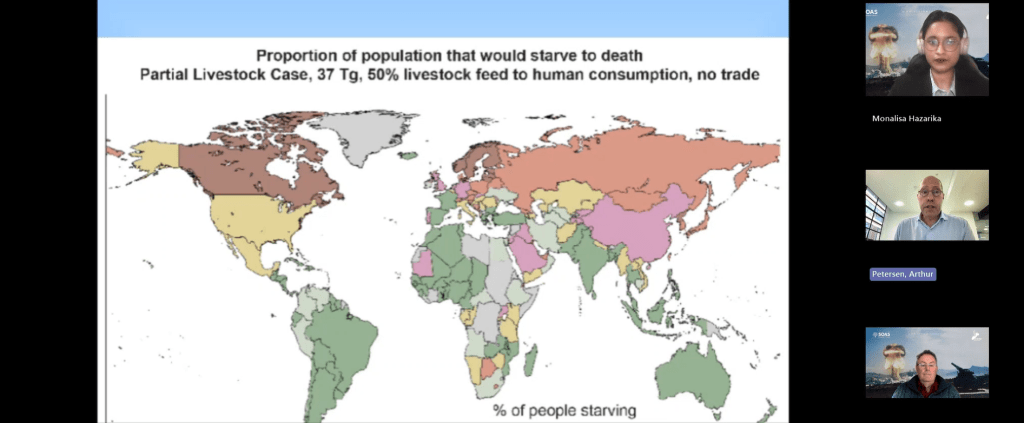
Professor Arthur Petersen (University College London) opened the panel with an overview of the environmental risks associated with nuclear weapons use. Drawing on decades of interdisciplinary research, he stressed the social responsibility of scientists to illuminate these risks, particularly the impacts of smoke from urban firestorms on global climate and food systems. Referencing recent studies and the 2025 US National Academies report, Petersen highlighted that while uncertainties remain, “moderate risks are validated,” and policymakers must not rely solely on best-case assumptions. He argued that decision-makers beyond the nuclear policy community must be made aware that even regional nuclear exchanges could devastate global agriculture and food security.

Prof. Dan Plesch, SOAS University of London

Professor Dan Plesch (SOAS University of London), Director of SCRAP Weapons, focused on the geopolitical implications of the impending expiration of New START. He warned that arms control and disarmament have largely fallen off the global agenda despite increasingly “casual rhetoric” around nuclear war. Plesch noted that nuclear winter is rarely factored into contemporary deterrence thinking or military planning, observing that “the risks and psychological pressures of deterrence failing into nuclear winter are almost never considered” in strategic studies or war-gaming exercises. He further highlighted the erosion of the firewall between conventional and nuclear weapons, arguing that blended strike doctrines increase uncertainty and escalation risks.

Prof. Alan Robock, Rutgers University

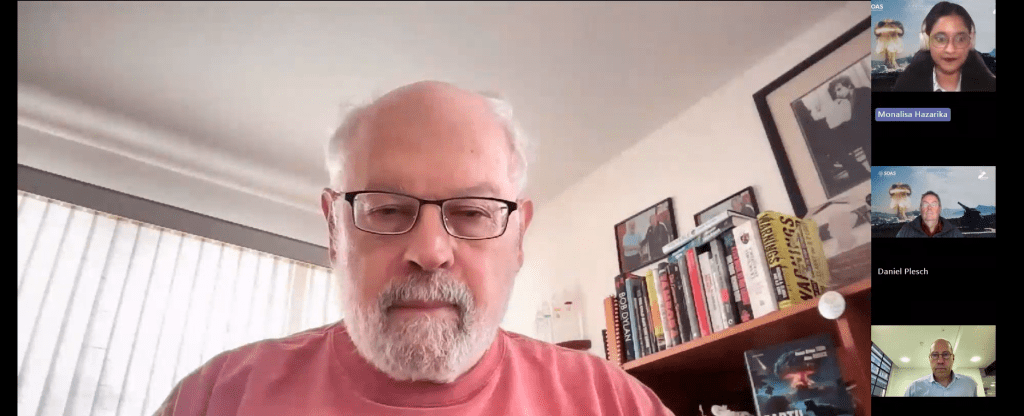
A key intervention came from Professor Alan Robock (Rutgers University), a leading climate scientist and pioneer of nuclear winter research. Robock emphasised that nuclear war poses an existential threat even to states not directly involved in conflict, noting that countries supporting the Treaty on the Prohibition of Nuclear Weapons already recognise that “they could suffer from a nuclear war, even if no bombs are dropped there.” He criticised the lack of government funding for nuclear winter research, arguing that if environmental impacts were fully acknowledged, “deterrence wouldn’t make sense—and that’s exactly the point”

The discussion also explored how to communicate nuclear winter risks without triggering fatalism. Panelists stressed the importance of offering clear avenues for action—through research, education, and engagement with policymakers, media, and academic institutions. As Plesch concluded, arms control and disarmament must be recognised as “realistic necessities, not liberal accessories”

The webinar closed with a call for renewed arms control efforts, greater investment in scientific research, and sustained public engagement. SCRAP Weapons announced that this discussion will be followed by additional events in the coming months, continuing efforts to re-center nuclear winter in global security debates and build momentum toward more ambitious weapons governance.

Monalisa Hazarika

Strategic communications and partnership officer, SCRAP Weapons