When Deterrence Meets Climate Catastrophe: Rethinking Nuclear Risk in a Post-Treaty World

When Deterrence Meets Climate Catastrophe: Rethinking Nuclear Risk in a Post-Treaty World

Monalisa Hazarika

Research and Strategic engagement officer, SCRAP Weapons
WATCH THE EVENT RECORDING HERE

On 27 February 2026, the SCRAP Weapons Project hosted its second webinar in the series, titled “Nuclear Winter and the Theory of Deterrence.” Moderated by Monalisa Hazarika, the session brought together leading scientific and policy voices to interrogate one of the most urgent yet under-discussed questions of our time: whether we consider the long-term climatic consequences of nuclear war when we assess deterrence theory.

Prof. Alan Robock, Rutgers University

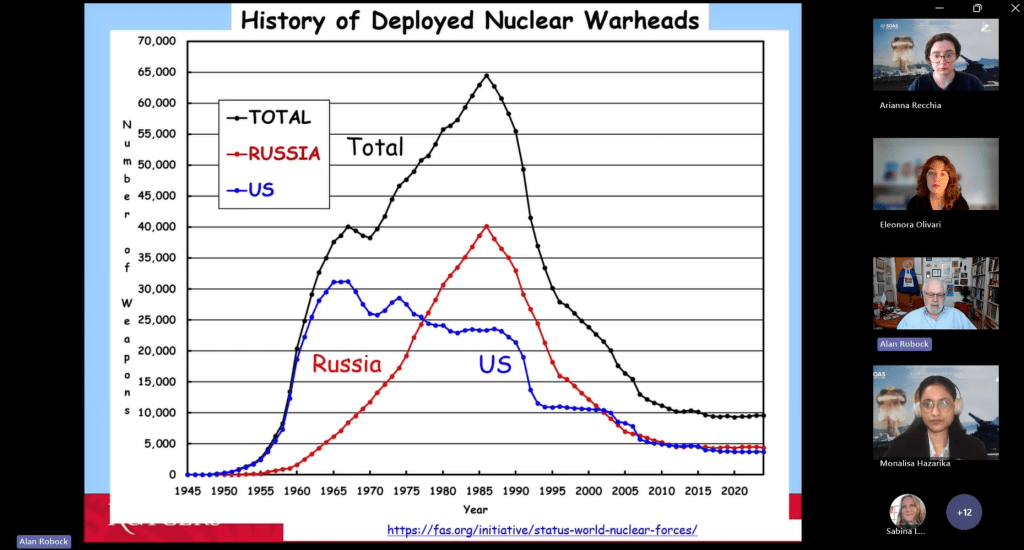
The discussion opened with a compelling presentation by Alan Robock, Distinguished Professor in the Department of Environmental Science at Rutgers University. Professor Robock outlined the scientific foundations of nuclear winter research, tracing its origins to early 1980s climate modelling and revisiting the updated simulations conducted with modern climate models. He explained how large-scale firestorms ignited by nuclear detonations would inject massive quantities of soot into the stratosphere, blocking sunlight, lowering global temperatures to Ice Age levels, reducing precipitation, damaging the ozone layer, and devastating global agriculture.

Drawing on recent peer-reviewed studies, Professor Robock demonstrated that even a “limited” regional nuclear war—for example between India and Pakistan—could cause severe global cooling and widespread crop failures. In a large-scale U.S.–Russia conflict, he warned, the resulting famine could kill the majority of humanity, far exceeding the immediate blast casualties. He challenged the strategic logic of deterrence, arguing that if the use of nuclear weapons would effectively amount to self-destruction through climate collapse, then the theory of deterrence rests on deeply flawed assumptions. His stark analogy—“We are the asteroid. We are the dinosaurs.”—underscored the self-inflicted nature of the risk.

Prof. Dan Plesch, SOAS University of London

The second presentation was delivered by Dan Plesch, Professor at SOAS University of London. Professor Plesch shifted the focus from physical consequences to political and doctrinal practice. He expressed concern that contemporary debates on deterrence, arms racing, and “blended” nuclear-conventional strategies are increasingly detached from their real-world humanitarian and climatic consequences. With major arms control treaties eroding and nuclear war games continuing among nuclear-armed states, he questioned whether policymakers meaningfully integrate the science of nuclear winter into their strategic calculations.

Professor Plesch also highlighted the growing convergence of nuclear risk and emerging technologies, noting recent reports that artificial intelligence systems participating in simulated war games frequently recommended nuclear use. This development, he argued, adds another destabilising layer to already fragile deterrence architectures. He called for a renewed public dialogue that bridges climate science, strategic studies, and global governance, including the possibility of new international frameworks—such as a “COP for Weapons”—modelled on climate diplomacy processes.

Ms. Eleonora Olivari, Project Assistant

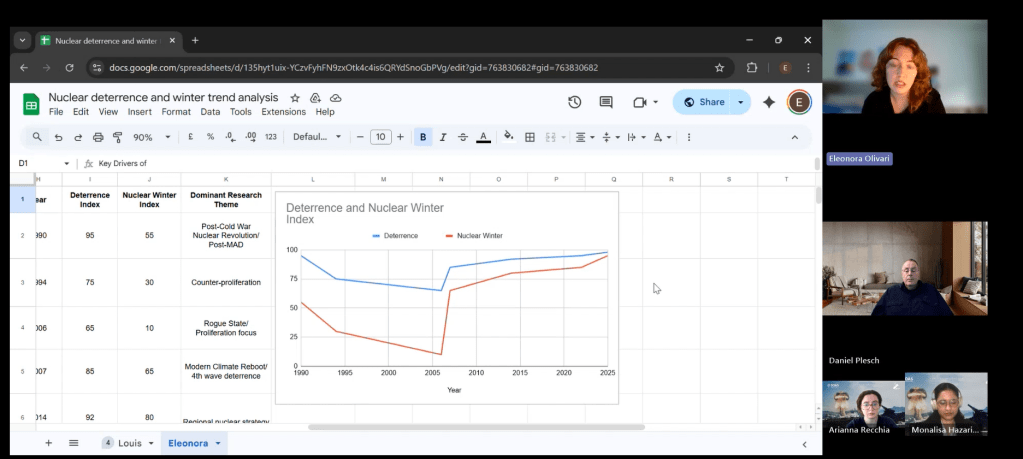
The final presentation came from Eleonora Olivari, a Master’s student at SOAS and Project Assistant at SCRAP. Presenting original bibliometric research conducted with AI-assisted tools, Olivari mapped academic trends on nuclear deterrence and nuclear winter from 1990 to 2026. Her findings revealed that while deterrence has maintained relatively stable academic attention, nuclear winter research experienced a “silent decade” between the mid-1990s and mid-2000s before a resurgence following updated climate modelling studies. Although recent geopolitical crises—particularly the war in Ukraine—have led to some renewed overlap between the two fields, the integration remains limited. The study suggested a persistent conceptual gap between strategic discourse and environmental consequence.

The discussion that followed engaged participants on issues ranging from India–Pakistan nuclear stability and NATO expansion to civil defence preparedness and the difficulty of mobilising public awareness. A recurring theme was the challenge of breaking through policy silos and public complacency in an era where nuclear weapons are often perceived as relics of the Cold War.

The webinar concluded with a shared recognition that nuclear winter is not merely a scientific hypothesis but a policy-relevant reality that must be reinserted into contemporary deterrence debates. As arms control frameworks weaken and technological risks intensify, the need to reconnect strategic theory with existential consequence has never been more urgent.

Monalisa Hazarika

Research and strategic engagement officer, SCRAP Weapons