

Newsletter August 2025
[NEW INITIATIVE] Disarmament Diaries
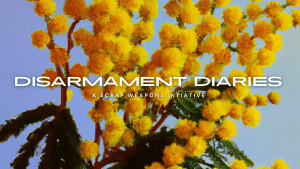
SCRAP Weapons is excited to announce its new flagship digital storytelling initiative, Disarmament Diaries, LAUNCHING NEXT MONTH!
This series is designed to amplify diverse voices from across the global disarmament community—youth leaders, mid-career professionals, seasoned diplomats, senior experts, and thought leaders—capturing lived experiences, powerful insights, and actionable recommendations. More than just a record, Disarmament Diaries is a platform for change. By sharing perspectives from across the peace and disarmament ecosystem, we aim to spark intergenerational dialogue, fuel public engagement, inspire policy action, and bring the vital work of conflict prevention and disarmament education to a wider audience.
More about the initiative here: https://scrapweapons.com/disarmament-diaries/
SCRAP Blog

Ever wondered about the story behind SCRAP Weapons’ striking background image—a mushroom cloud looming in the distance with a cannon pointed straight at the explosion? Was it AI-generated? A deliberate artistic choice to mirror our research and advocacy on disarmament? Or a clever piece of branding with a hidden message?
Our Communications Officer, Monalisa Hazarika, turned her curiosity into a captivating piece of Cold War history! In her latest blog, she uncovers the fascinating tale of “Atomic Annie” and the “imposter” Sad Sack—a story that sheds light on a pivotal moment in history.
“Turns out the image isn’t just for dramatic flair. The image captures a historic moment of the detonation of an artillery-fired atomic projectile (AFAP) from a M65 Atomic Cannon, also known as Atomic Annie. The AFAP was a nuclear artillery shell, fired from a 280mm artillery gun to a range of 13 miles.”
Read the full blog here: https://scrapweapons.com/scrap-weapons-and-atomic-annie/

Reflecting on the 2025 Hague Summit, SCRAP Weapons’ Project Assistant Annabel Ludhra argues that not every nuclear threat has to be answered with a nuclear response. The technical responses from Europe must be accompanied by robust and global arms control and disarmament projects
“Germany has decided to engage with France and the UK on the sharing of nuclear weapons. This is in direct response to the Janus-like uncertainty of President Trump’s rapprochement with Russia over NATO, alongside the growing certainty of a multi-order world, where the US’ interests no longer centre around Europe, but rather the Asia-pacific. Doing so has rekindled the old Cold War desire for non-American nuclear dependency – a Euro-bomb.”
Read the full blog here: https://scrapweapons.com/the-eurobomb-in-light-of-the-2025-nato-summit/
Arms and Arguments: AUGUST EDITION

This August, the “Arms and Arguments” Book Club is delving into a crucial conversation. Project Assistant Mila King highlights a key insight from our latest read, Robert Jacobs’ 2022 article “Global Hibakusha.”
“Jacobs challenges the conventional view that nuclear destruction is limited to desolate, irradiated landscapes from external exposure. Instead, he highlights the danger of microscopic fallout particles that are absorbed by and enter the human body. Though not instantly lethal, these particles gradually undermine health, often taking years to manifest in disease…
Perhaps most striking is how he frames nuclear testing as an extension of colonialism. Governments, fully aware of the risks, conducted tests in regions with populations considered expendable, thus effectively “selecting the irradiated”. Jacobs’s work insists that we confront the enduring legacy of these policies. This article is both a historical analysis and a moral imperative, urging readers to reckon with nuclear fallout’s human and environmental toll.”
Read the review here: https://scrapweapons.com/arms-and-arguments/
Publications

SCRAP Weapons’ Communications Officer, Monalisa Hazarika, recently published a commentary, “Youth and the Generation of Global Hibakushas,” with the Asia-Pacific Leadership Network!
In this piece, she reflects on eight decades of nuclear devastation and explores how communities—from the Pacific Islands to Central Asia to Indigenous populations—have been disproportionately affected across generations. She argues that while Hibakusha bear witness to the past, a new global generation of hibakushas continues to emerge—one shaped by the ongoing legacy of nuclear testing, environmental injustice, and systemic inequality. Crucially, youth today are demanding change—not just for disarmament, but for justice, transparency, and reparation.
Read the article here: https://www.apln.network/analysis/commentaries/youth-and-the-generation-of-global-hibakushas