

Newsletter August 2023
Revisiting Disarmament and Arms Control: Progress or Regression? – A Geneva Security Debate
What are the challenges and opportunities to the disarmament and arms control machinery and treaties? What role do these mechanisms play at a time of uncertainty in international politics? Are and can these mechanisms and treaties contribute to peace and security?
Date: Tuesday, 19 September 2023
Time: 12:30-14:00 CET
Location: Hybrid – Geneva Centre for Security Policy and virtually
In June 1945, as a catastrophic global conflict of unprecedented scale was coming to an end, the United Nations was created, “to save succeeding generations from the scourge of war, which twice in our lifetime has brought untold sorrow to mankind”. A central goal of the new organization was “to establish conditions under which justice and respect for the obligations arising from treaties and other sources of international law can be maintained”.
In the decades that followed, the disarmament and arms control community sought to turn the tide on militarism and initiated mechanisms and key instruments on disarmament and arms control. With the establishment of the Conference on Disarmament, Geneva was recognized as the principal multilateral platform for disarmament and arms control. Both inside and outside the Conference on Disarmament, there have been considerable successes such as the Arms Trade Treaty, Biological Weapons Convention, Chemical Weapons Convention, Non-Proliferation Treaty, Comprehensive Nuclear-Test-Ban Treaty, Convention on Anti-personnel Landmines, Convention on Cluster Munitions and Treaty on the Prohibition of Nuclear Weapons, as well as strategic bilateral, and regional agreements.
Despite the recognition of the founders of the United Nations that disarmament was a fundamental requirement for peace, the commitments undertaken have been steadily replaced by a short-sighted determination to pursue security through force of arms. Disarmament and arms control fora and treaties are abandoned, obstructed, neglected or simply ignored, in favor of increasingly frantic and expensive races to acquire more, newer and better weapons and the political freedom to use them.
At this time what are the challenges and opportunities to the disarmament and arms control machinery and treaties? What role do these mechanisms play at a time of uncertainty in international politics? Are and can these mechanisms and treaties contribute to peace and security? And if not, why not? Is the all-pervasive rule of consensus the problem? What could be the way forward?

Spotlight
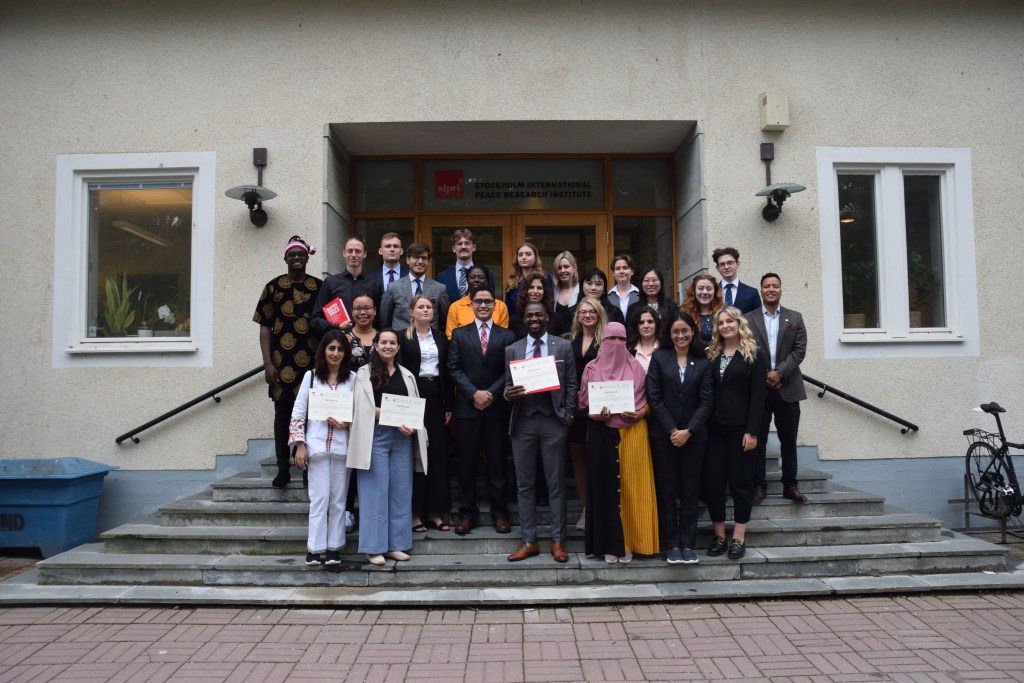
From 21–25 August, two of our Project Assistants, Vanessa Canola and Monalisa Hazarika, participated in the 2023 Armament and Disarmament Summer School organized by the Stockholm International Peace Research Institute (SIPRI) in cooperation with the Alva Myrdal Centre for Nuclear Disarmament at Uppsala University and the Odesa Center for Nonproliferation (ODCNP). The program provided 26 emerging experts and scholars coming from 21 countries with different backgrounds (ranging from multilateral diplomacy and law to astrophysics), with the opportunity to deepen their knowledge and broaden their professional horizons in the fields of disarmament, non-proliferation and arms control. Through a series of lectures, workshops and seminars covering a wide range of thematics, including autonomous weapons, space security, arms transfers, export controls, OSINT, weapons of mass destruction and nuclear engineering, the Summer School provided the cohort with a framework to foster dialogue, knowledge-sharing, and the emergence of fresh ideas in the name of peace, nuclear disarmament and non proliferation.

As part of Youth Fusion’s project ‘Youth Hotline Campaign’, SCRAP Weapons’ Project Assistant, Philip Chennery, and his team developed the Nuclear Shades initiative, a simple and interactive Instagram account that helps spread awareness about perspectives as well as information on the use and impact of nuclear weapons. Head over to Instagram to check it out!
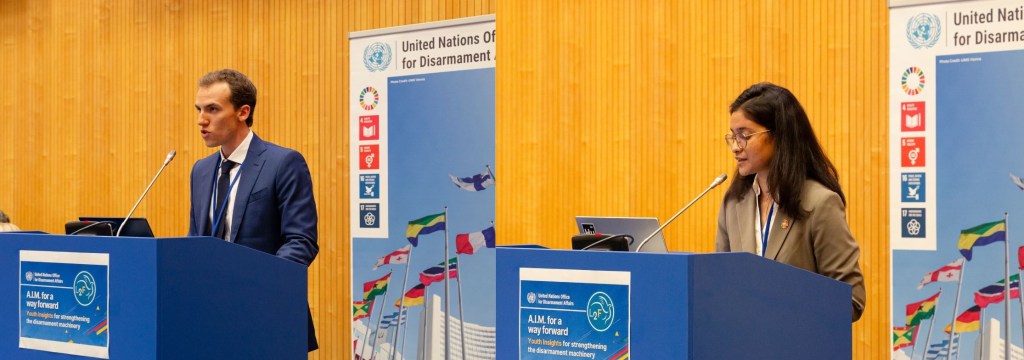
Two of our Project Assistants, Monalisa Hazarika, and Philip Chennery, participated in a United Nations study trip to the United Nations Office in Vienna as part of the #Leaders2Future series. At “A.I.M (Advocates in Motion) for a Way Forward”, UNODA’s official side event to the NPT Preparatory Committee, they presented their insights for approaching threats posed by new and emerging technologies and recommended practical steps to strengthen diversity in the disarmament field. Further, at the Mayors of Peace Youth Forum, Monalisa presented her project “Across the Chicken Neck: Exploring Disarmament from Indigenous Perspectives”, to highlight the importance of disarmament education and initiatives for and by youth. The program also consisted of consultations with H.E Ms. Izumi Nakamitsu, Mr. Youn Jong Kwon, and various UN entities and organizations including UNODC, CTBTO, UNOOSA, and a field trip to the IAEA headquarters.