

Beyond Deterrence: What Hiroshima Teaches Us About Responsibility and Remembrance


Monalisa Hazarika
Strategic Communications & Partnership Officer, SCRAP Weapons
Organized by the Hiroshima Prefectural Government, in collaboration with the International Campaign to Abolish Nuclear Weapons (ICAN) and Peace Boat, I had the privilege of attending the 2025 ICAN-Hiroshima Academy on Nuclear Weapons and Global Security held from October 14 to 18 in Hiroshima, Japan. The program consisted of a five-day training program that combined fieldwork, lectures, group discussions, and reflection sessions. A total of 20 participants between the ages of 18 to 25, from both Nuclear and Non-Nuclear Weapon countries, representing gender and geographical diversity, engaged in this intensive program, following a month of intensive coursework and webinar sessions.
About the program
Day 1 of the program began with a profound exploration of the lasting impact of the atomic bombing of Hiroshima through a guided tour of the Hiroshima Peace Memorial Park. The visit included some of the most symbolic landmarks — the A-Bomb Dome, the Cenotaph for the A-Bomb Victims with its eternal flame, and the Children’s Peace Monument. Each site carried both historical depth and human stories that connected the past to the city’s enduring message of peace. It was striking to observe the intentional design of the park, where every monument and memorial tells a story — from the Monument to Korean Victims and Survivors to the layout that encourages remembrance and reflection.
Later in the day, we had an engaging discussion with Governor Hidehiko Yuzaki, during which I asked, “How can prefectural and municipal governments like Hiroshima’s better integrate young people — locally and globally — into ongoing peace and disarmament initiatives, beyond symbolic participation?” The day concluded with a reflection session and a welcome dinner with Hibakusha, where we exchanged stories about what continues to inspire and sustain our commitment to peace and disarmament.
Day 2 of the program delved into the deeply human dimension of the Hiroshima experience. The day began with breakout discussions with Hibakusha and atomic bomb legacy successors, who shared powerful stories about both Japanese and non-Japanese victims and survivors — and the enduring discrimination many faced before and after the bombing.
One story that stayed with me was that of Lee Jong Keun, a Korean who lived in Japan during the annexation of Korea. Hearing his account through Ms. Mozume Megumi, who has dedicated her life to documenting and advocating for Korean Hibakusha, was profoundly moving. Through her, I came to understand the layers of historical injustice, dual discrimination, and emotional trauma that survivors endured — and how the aftermath of the bombing only deepened their suffering. The censorship (both imposed and self-inflicted), the lack of knowledge about radiation’s effects, and the shaping of public narratives all helped me contextualize many of the writings I had previously encountered — and suddenly, much of it began to make sense.
Later, we took a guided tour of the Hiroshima Peace Memorial Museum — an experience that was, in a single phrase, deeply traumatic yet profoundly necessary. From the recreated scenes around the hypocenter to the preserved artifacts, testimonies, and photographs of those directly affected, the visit left me speechless and humbled by the sheer magnitude of loss and resilience on display. It was what I would call a “sponge moment” — one where all I could do was absorb, reflect, and feel. We ended the day on a forward-looking note with an advocacy session led by Florian from ICAN, who guided us through creative exercises on crafting impactful and persuasive pitches for the Treaty on the Prohibition of Nuclear Weapons (TPNW). It was an inspiring close to a day that balanced deep reflection with renewed motivation to act.
Day 3 focused on uncovering the lesser-known human impacts of nuclear devastation, with sessions on Nagasaki and the experiences of Kinokokai (individuals suffering from A-bomb–related microcephaly). Through a series of documentaries and discussions, we explored how the struggles for recognition as Hibakusha differ yet often overlap between Hiroshima and Nagasaki, and how culture, society, and religion have shaped the narratives surrounding each city’s experience.
Learning about the lives of Kinokokai was particularly moving. Their suffering extended far beyond personal health challenges — it deeply affected their families, caregivers, and entire communities. Many of them remain unrecognized and invisible in the broader history of the atomic bombings, their stories hidden beneath layers of silence, stigma, guilt, and collective memory. It was a sobering reminder that the legacy of nuclear weapons is not confined to history books or policy debates. It lives on in the quiet, often overlooked corners of human experience.
Day 4 offered a more hands-on and immersive experience, combining field visits with direct conversations. The day began with an insightful session with Mr. Mikiharu Nakai, Deputy Mayor of Hiroshima City, who spoke about the city’s ongoing peacebuilding efforts and the important role of Mayors for Peace in promoting nuclear disarmament and global cooperation. I was also interviewed by a local newspaper, where I shared my reflections on meeting the Deputy Mayor and my impressions of Hiroshima — a city that continues to embody both the pain of its past and the strength of its recovery.
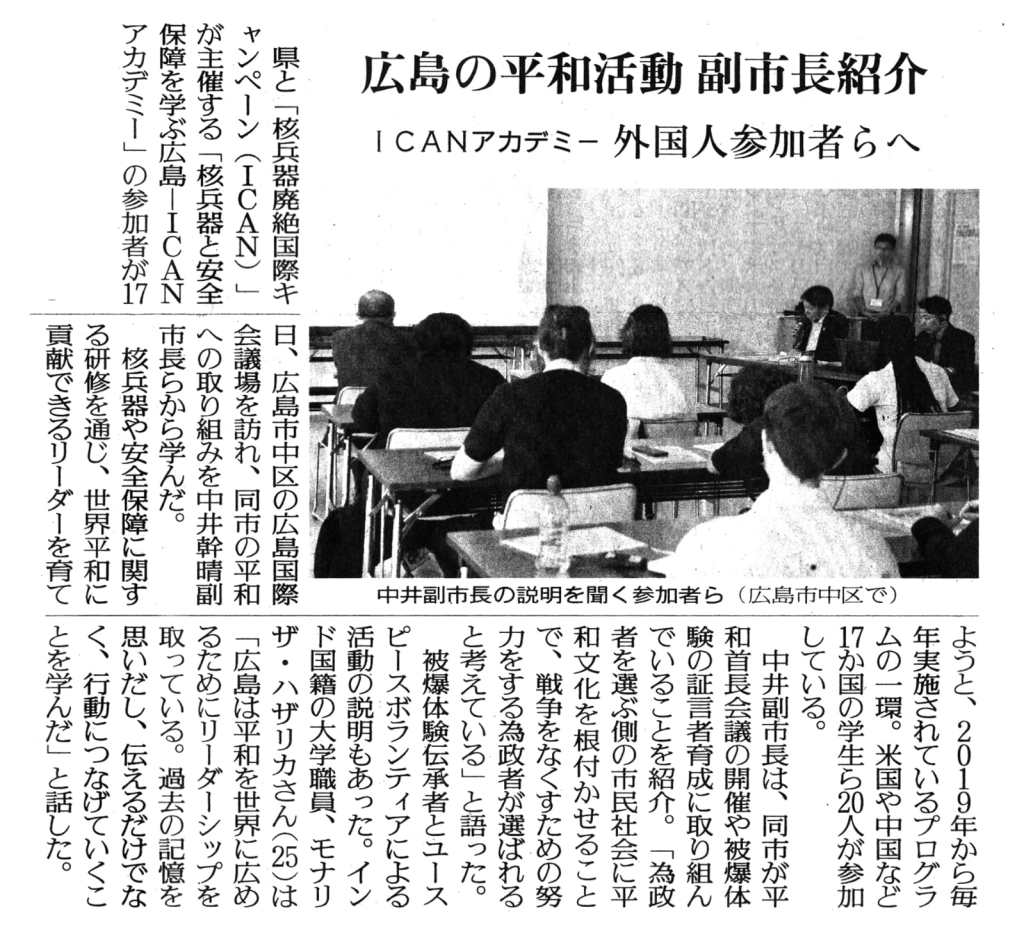
Later, we visited the Radiation Effects Research Foundation (RERF), formerly the Atomic Bomb Casualty Commission (ABCC), to learn about its vital work in documenting the long-term effects of radiation exposure and in preserving the legacy of the Hibakusha through science and memory. The day concluded with a guided visit to the nearby Army Cemetery, where we learned about life under Japanese imperialism, adding yet another historical layer to our understanding of Hiroshima’s complex past.
The fifth and final day of the program was devoted to a collaborative reflection and presentation exercise, where participants came together to share their key takeaways and insights. The session was recorded and attended by past speakers, Hibakusha, and members of the local media, making it a meaningful conclusion to an inspiring week.
Reflections
Hiroshima is not only a site of unimaginable suffering but also a living testament to resilience, moral courage, and the human will to rebuild. The symbolism of this place transcends any international relations lesson I attended at University as it invites us to internalize the strength of its people and its nature. Hiroshima remains an enduring counter-narrative — one rooted not in fear as seen in Arguments around deterrence, but in remembrance and responsibility, especially in today’s politically fragile and polarised world. The city reaffirms the moral imperative to ensure that military power and ultimately the ego of a few never again eclipse humanity and compassion.
I come here as part of a generation that did not witness what happened in Hiroshima 80 years ago, but lives daily with its consequences as a global citizen, ultimately dealing with its impacts on the political, ethical, and existential spaces. In this context, Hiroshima bridges that gap between memory and action with its city-level diplomacy, peace education, and the balance between commemoration with innovation.
I see Hiroshima’s moral leadership as essential in revitalizing global conversations around disarmament. It teaches us that remembrance is not a passive act. It compels us to work, to speak, and to imagine alternatives to violence. As a young person working in the field of disarmament and arms control, this visit reaffirms my commitment to ensuring that the story of Hiroshima is not one of the past, but of our collective future and that their testimonies and history is reflected in my work.
Perhaps the most enduring takeaway from this engagement is not a definitive conclusion, but rather a profound clarification of the questions that must now define my path forward. This program has created an intellectual and moral framework, challenging me to seek answers through dedicated professional work. Specifically, I am driven to explore the deep inquiries that remain in my mind: How does being here fundamentally alter my understanding of “nuclear deterrence” and its moral assumptions? What would a truly integrated remembrance culture, which centers youth perspectives, look like? And critically, how do places like Hiroshima shape our collective imagination of responsibility in an age of ongoing global conflict?
My next steps are thus less about achieving fixed answers and more about sustaining the rigor of questioning, committing my career to tackling these specific challenges, and continually drafting new, critical inquiries as I proceed.
Monalisa Hazarika
Strategic Communications & Partnership officer, SCRAP Weapons