

‘A House of Dynamite’ is a great film, which gets nuclear security dangerously wrong. Why does that matter?

Ashoka Bandi Phillips
Project Assistant, SCRAP Weapons
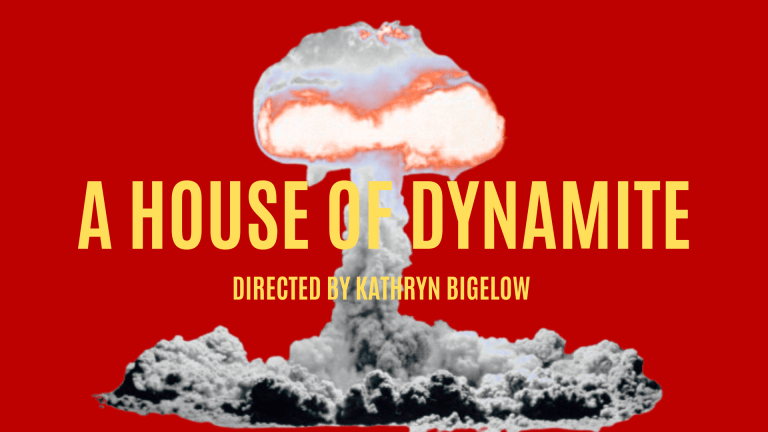
Kathryn Bigelow’s new film, ‘A House of Dynamite,’ is a gripping apocalyptic political thriller. The eighteen minute countdown to a potential nuclear strike on the continental United States keeps the audience constantly on edge and sympathising with the various actors involved in thwarting and responding to it. The performances are strong, and the technical filmmaking is excellent. Most importantly, the film succeeds at one thing: making nuclear weapons anxiety feel tangible and justified, as the audience and cast come to terms with the destruction of Chicago, the topic of nuclear annihilation becomes harder to ignore.
For the above mentioned positive aspects of the film, it deserves much of the credit it has gotten. Most people rarely give much thought to nuclear weapons, and older films often come across as dated relics of the Cold War or reduce the subject to a purely philosophical abstraction. In fact, I’d argue that the anxiety of nuclear annihilation is more palpable in this film than even Dr Strangelove, a SCRAP Weapons favourite. It cuts through the cold mathematical language that often surrounds Mutually Assured Destruction and shows what a crisis actually looks like in practice.
The three parallel narratives, in the white house situation room, the STRATCOM command centre, and through the president, reveal the genuine fractures between different institutions and the human error that may result in a massive catastrophe.
The problem is not with how it conveys the human psyche, but something deeper.
What the film gets right
Before we get to where the film falters, what does Bigelow actually accomplish?
Firstly, the non-linear narrative structure reveals something true about nuclear command authority: It is fragmented, chaotic, and operates under impossible time pressure with limited information. The President is paralyzed by contradictory advice from the Deputy National Security Advisor and Military commanders. The film’s treatment of attribution ambiguity is a particularly strong aspect of the movie. Throughout the whole eighteen minutes, no one can determine who launched the missile. In the real world, this level of ambiguity stops those with command authority from calculating a ‘proportional response.’ The film also effectively shows how technological solutions may fail. Even the most advanced American defence systems cannot guarantee protection. No amount of investment in missile defence can ever ensure complete reliability. Many citizens of nuclear-armed states believe their nations can shield them; this film dismantles this illusion.
The last thing the film gets right is the human dimension to nuclear warfare. The suicide of the Secretary of Defence, and Major Gonzalez’s vomiting outside Fort Greely, is not merely just melodrama, but a plausible response to how the humans responsible for protecting us are just as likely to break down under pressure, just as any other human. The psychological and moral burden of nuclear responsibility is felt by all actors.
Where the film fundamentally fails
But here is something the film doesn’t ask: Why does this system exist at all?
The film shows us how missile defense fails, how decision makers become paralysed, and how a nuclear crisis forces impossible choices. The film treats this as a mere reality we must learn to live with. This is where we must part ways with Bigelow’s vision. While it shows how the deterrence system is flawed, it fails to build upon this to advocate for its dismantling.
The film’s ending deliberately withholds the choice made by the President to respond to the nuclear strike, and we are left suspended in the crisis with no alternatives. What if we didn’t accept nuclear weapons as inevitable? What if we recognized them as policy choices rather than an inherent feature of the international?
The film presents deterrence as the only available framework to the president. General Brady recommends an immediate strike, Baerington recommends restraint; Both positions operate within deterrence logic. Neither character questions whether deterrence itself is the problem, and as a result, neither does the film.
What’s the solution the film doesn’t show you?
Comprehensive disarmament already has proven frameworks we can build on. The 1987 INF treaty, built upon SALT I and II, between the United States and the Soviet Union, eliminated an entire class of nuclear missiles. To this date, nothing mentioned in that treaty has been violated, and no secret weapons programmes have been unearthed. Building trust through transparency isn’t just hypothetical; it has been done before.
European nations have treaties governing conventional weapons that have been held for decades. Strong verification methods have assisted in compliance. UN developed inspection programmes have ensured compliance in Iran and Iraq and successfully identified and destroyed weapons of mass destruction through verification and transparency. OSINT has democratized verification, granting independent civilian organizations the ability to challenge statements made by their governments.
The broader picture: Beyond just nuclear annihilation
The world spent 2.7 trillion USD in 2024 on maintaining nuclear weapons and armed forces. That is a huge amount of money.
According to the United Nations, with that money, you could work towards providing universal healthcare, address climate change, build institutional capacities in developing nations, and work towards poverty alleviation and reducing inequalities. Instead, that money is used to buy weapons. Arms races consume resources that could address urgent development needs.
‘House of Dynamite’ is entirely focused on American security, not on why the United States continues to maintain the world’s largest nuclear arsenal. It does not show how the consequences of militarization have affected the global south and how those who advocate for increased military budgets are often those who personally benefit the most from it. This omission matters because it reflects a political choice.
Whose security do we pay attention to? Whose vulnerability merits attention? And whose is ignored?
The Verdict and the future of Nuclear weapons in film
Despite this, ‘A house of Dynamite’ is an excellent film. It shows us how it only takes one failure in judgment to destroy the world, but it doesn’t go further than that to show us alternatives. When a well made film with compelling dialogue presents deterrence as inevitable, it subtly reinforces a security paradigm that must be fundamentally transformed. While we acknowledge Bigelow’s creative direction, we reject the conclusion. Real disarmament requires moving beyond immediate crisis management and towards tried and tested weapons elimination programmes. ‘A House of Dynamite’ has contributed to the anxiety around nuclear weapons, but we need to look beyond that.
We need to recentre the debate around political mechanisms required for complete disarmament and the social and political consequences of maintaining large military budgets.
Ashoka Bandi Phillips
Project Assistant, SCRAP Weapons