

Back to the “Future” or Stuck in the Realms of Cold War:
The UN Summit of The Future

Monalisa Hazarika
Project Assistant, SCRAP Weapons
Earlier this year, I had the privilege of attending the Summit of the Future conference and the Actions Days at the UN Headquarters, a high-level event that brought together representatives from Member States, civil society, the private sector, academia, and local and regional authorities. Convened on 20 and 21 September to generate additional opportunities for the broad engagement and inclusion of all, the Action Days kicked off with a youth-led afternoon followed by a Saturday program that focused on three priority themes – digital and technology, peace and security, and sustainable development and financing. In addition to the three themes, there was also a dedicated focus on future generations throughout the day which was reiterated and echoed by multiple member states. In essence, the Summit aimed to tackle the challenges of tomorrow and explore the transformative opportunities that lie ahead.
Behind the Scenes
The proposal for convening the Summit of the Future originated in UN Secretary-General Antonio Guterres’ Our Common Agenda report released in 2021. The report was a response to a call from Member States for ideas on how to better respond to current and future challenges and contained recommendations to make amends and commit to concrete action-oriented steps forward. In July 2023, the Secretary-General presented his policy brief A New Agenda for Peace which outlines his vision for multilateral efforts for peace and security and contains inputs for Member States’ consideration ahead of the Summit of the Future.
Following his lead, practical consultations on preparations for the Summit began in February 2023 and lasted for more than a year. During this period, member states deliberated on forging a new international consensus on upholding commitments negotiated long ago, delivering policies for a better present, and safeguarding the future for all involved. These discussions were held behind the backdrop of a geo-political atmosphere fraught with mistrust and operating on outdated structures that no longer reflect today’s political and economic realities.
Expectations vs. Reality
Heading into the Summit, I had high expectations. It was a once-in-a-generation opportunity to mend fractured relationships and demonstrate renewed cooperation to tackle novel threats affecting mankind as a whole. I anticipated kinetic discussions on emerging technologies, global sustainability goals, and the socioeconomic challenges that lie on the horizon. I also hoped for actionable solutions rather than just high-level discourse and “good to have” language—a challenge many such events often face.
What I encountered exceeded my expectations. The sessions weren’t just theoretical; they were immersive, solution-driven, and above all, felt humane and grounded. With its strong focus on cross-sector collaboration, there was a palpable energy of determination and hope in the meeting rooms as leaders across all ages worked together to bridge the gap between vision and reality. A spring in their step, everyone in the building seemed optimistic about what lies ahead.
Key Highlights from the Summit Action Days
In an era marked by increasing polarization, global north-leaning policies, and a perpetual state of conflict, the summit hosted events around a digital, peaceful, and sustainable future for all. It covered a wide range of themes and issue areas, the most intriguing being the role of AI in solving global issues; sustainability as a priority, not an option; fostering international cooperation and unity by decentralizing platforms for global governance; and addressing socio-economic disparities and gaps.
One of the most engaging aspects of the summit was the focus on inclusivity in shaping the future, especially its #YouthLed opening ceremony and a dedicated action day to meaningfully engage marginalized voices, youth leaders, and grassroots organizations. Their perspectives added a refreshing depth to the discussions and reinvigorated the often siloed forums.
SCRAP at the Summit
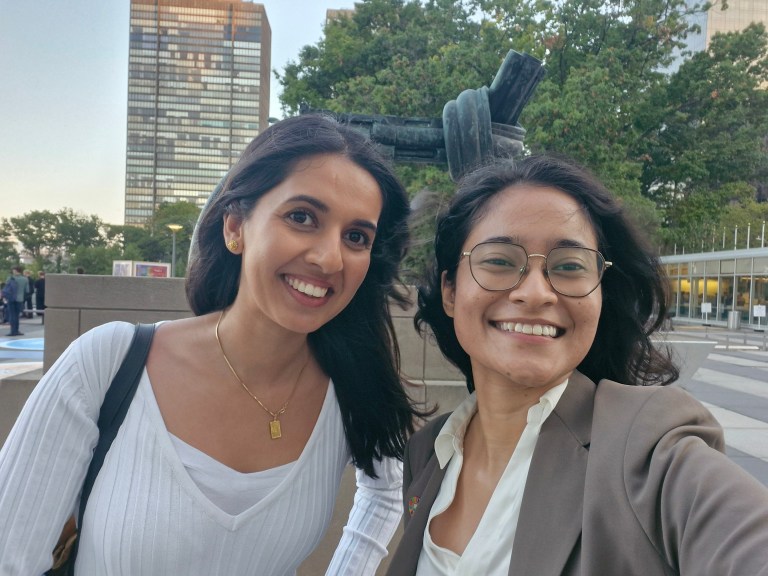
Along with my colleague Zahraa Kapasi, SCRAP Weapons attended various events and organized their own official side event highlighting the unprecedented rise in global military spending and arms trade, and recommending the establishment of a concrete deadline for Member States to agree on convening the Fourth Special Session on Disarmament (SSOD-IV).
On 21 September, SCRAP Weapons, in collaboration with Kiribati, the International Peace Bureau (IPB), and other co-sponsors, organized an official side event to the Summit of the Future Action Days titled “Reversing the Doomsday Clock: Nuclear Disarmament and the Need for Fourth Special Session on Disarmament”. Held at the Church of the Covenant, the event was graced by opening remarks from Kiribati Ambassador Teburoro Tito, Reverend Cornell Edmonds, Lynnaia Main, and Archbishop Wester of New Mexico. This was followed by an incredible panel of speakers that featured experts from academia, policy, civil society, and indigenous communities who delivered remarks on topics ranging from human security, military expenditure, climate crisis, victim remediation, and the need for a Special Session on Disarmament.
I also had the opportunity to speak at the International Peace Bureau (IPB)’s official side event to the Summit of the Future Action Days titled “Common Security, The New Agenda for Peace, and the Pact for the Future: Redefining Security for the 21st Century” held at the Rosa-Luxemburg-Stiftung, NY Center. Sharing the panel with Joseph Gerson, Executive Director at Campaign for Peace, Disarmament, and Common Security, I talked about the concept and values of collective security as understood in the New Agenda for Peace, how it overlaps with the idea of common security, and how it all relates to multilateralism and the shifting world order.
Followed by the eventful Action Days, the actual Summit was held on 22 and 23 September where the Pact for the Future and its annexes–the Global Digital Compact and Declaration on Future Generations—was negotiated and adopted by member states. An inter-governmentally negotiated action-oriented document under the leadership of Namibia and Germany, the Pact for the Future was the outcome of the Summit that demonstrates their commitment to an international system—with the United Nations at its center—and serves as a blueprint for multilateralism that engages and represents the expertise of governments, civil society, academia, and other key partners. However, the adoption was not devoid of pushbacks and last-minute attempts of amendments made by Russia to derail months worth of consultations and consensus-building among actors. In the end, in a historic motion proposed by the Republic of Congo that no action be taken on the draft amendment, a vote was held where the motion was adopted by a recorded vote of 143 in favor to 7 against and 15 abstentions. This resulted in the adoption of the resolution titled “The Pact for the Future” (document A/79/L.2) without a vote.

Looking Ahead: Building on the Momentum
As the Summit concluded, I found myself optimistic yet aware of the significant work that lies ahead. The event served as a powerful reminder that we are all stakeholders in shaping the future and underscored the importance of accountability and follow-through in our actions. As a professional in the civil society realm, I am looking forward to seeing the tangible outcomes of the commitments made at the summit, greater and meaningful participation of underrepresented groups in global decision-making, and how we can hold our governments accountable for their action and the lack thereof. With the rapid advancements in technology, I am curious to see that being materialized into prioritizing humanity and the planet and a shift from short-term problem-solving to long-term systemic change.
As a call to action, the Summit of the Future served its purpose—to imbibe a renewed sense of purpose, build a mutual ground for collaboration and innovation, and remind us that this is our only chance to save humanity from ourselves. It all comes down to how well we hold onto these shared values and our determination to carry this forward, especially during the current challenging times.
Monalisa Hazarika
Project Assistant, SCRAP Weapons